A novel asks a beginner for weeks of trust. A short story asks for one evening. That is the whole reason to start with stories: you finish something, you know what you understood, and you can decide what to read next while the feeling is still fresh.
This guide is for a reader around A1 to A2 who can read simple English sentences but has not yet finished a whole English text. If you can follow "She opened the door and went out" without stopping, you are ready for the stories below.
What makes a story a beginner story
Beginner means you can follow the plot, not that every word is easy.
A story earns the label when three things hold. First, you can finish it in one sitting without dreading the next page. Second, you can follow the plot even when some words escape you. Third, the unknown words are the point of the story, not a wall across every sentence.
Length is a weak signal on its own. A 500-word story packed with idioms and old-fashioned words is harder than a 2,000-word story written in plain present tense. Judge by the first page, not the cover promise.
Free stories to start with tonight
Start free, because the first question is not which book to buy. It is whether stories at this level feel readable at all.
British Council LearnEnglish Story Zone publishes free stories written for A2 to B1 learners, each with exercises. Start with "First star I see tonight" or "Bad blood". The stories are short, the language is controlled, and the exercises tell you right away what you missed.
Project Gutenberg gives you the classics free, in the public domain. "The Gift of the Magi" by O. Henry (first published 1905; Gutenberg eBook #7256) is the best first classic for a beginner: a young couple, two gifts, one twist, and a plot you can retell in three sentences. The language is over a hundred years old in places, so a few words will look strange. The plot carries you past them.
Read one free story tonight, then listen to it. Free audiobook versions of the same public-domain stories exist on LibriVox. Read first, listen second, read again. The second read is where the words stick.
The first collection: pick one, not three
Once a free story feels readable, buy one collection and finish it. Two are well documented, and they form a ladder, not a choice.
Short Stories in English for Beginners (Olly Richards, Teach Yourself, 2018, 252 pages, ISBN 9781473683556) holds eight stories mapped to A2–B1: science fiction, crime, history and thriller, written for adults, not children. The everyday vocabulary is the point. You meet the English of daily life, not the English of fairy-tale castles.
Short Stories in English for Intermediate Learners (Olly Richards, Teach Yourself, 2019, 256 pages, ISBN 9781529361568) holds eight more stories at B1–B2. Buy it when you finish the first book, not before. It is the next rung, and it works because the format is already familiar.
One finished collection teaches more than three half-read ones.
A note on the label: "beginner" on a cover does not guarantee every story stays easy. Later stories in a book are often harder than the first. That is normal, and it is another reason to sample the first story before buying, rather than trusting the label.
Stories you already know
The easiest story to read is one whose plot you already know. When you know the wolf is coming, you can spend your attention on the language instead of the plot: which tense the narrator uses, how the wolf is described, where the joke lands.
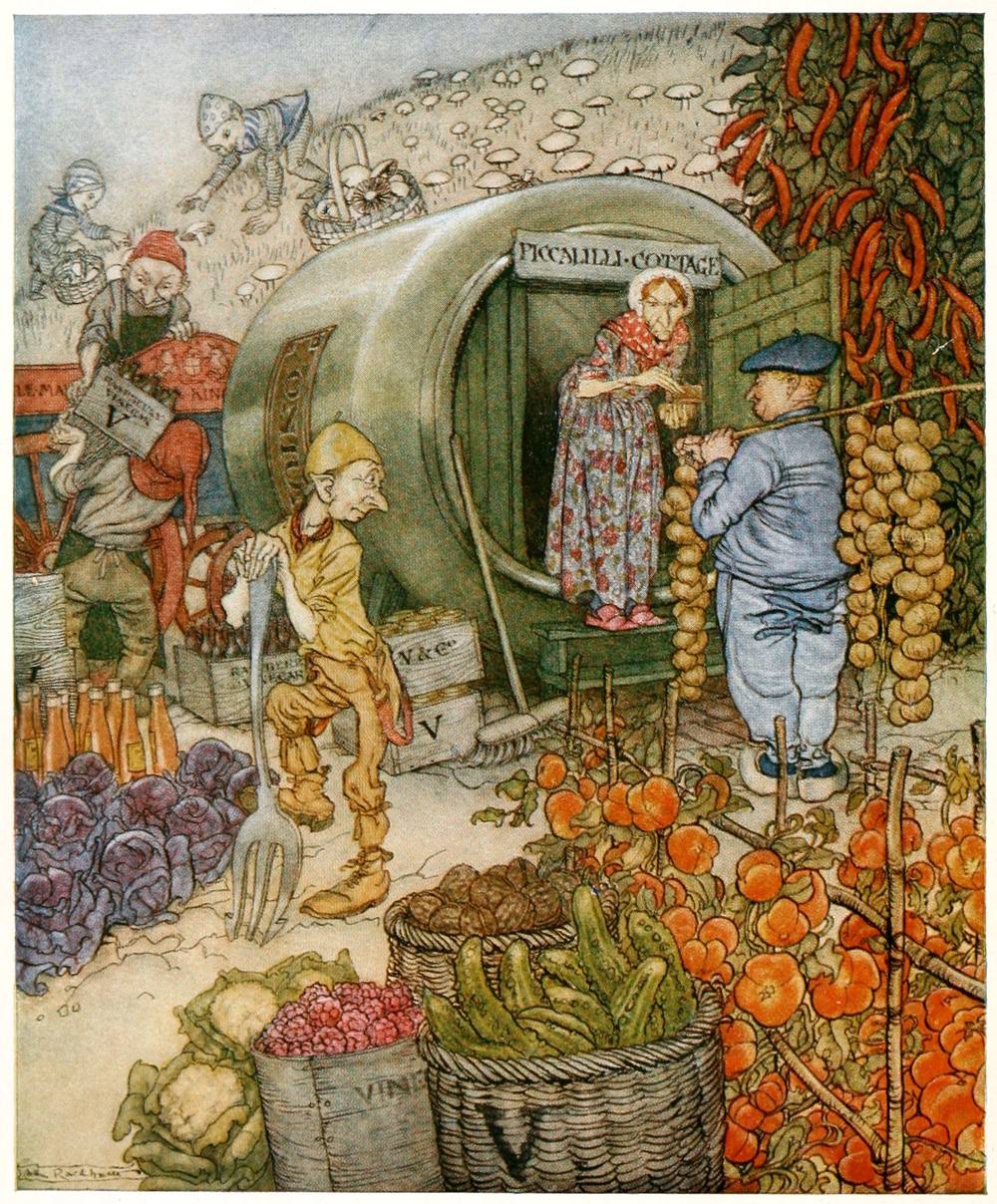
Three to start with are "Cinderella", "Little Red Riding Hood" and "The Three Little Pigs". They exist in graded versions for learners, and in the original fairy-tale collections too. The picture on this article comes from one of those collections: Arthur Rackham's frontispiece to English Fairy Tales (1927), a book of the tales English children grew up with.
Aesop's fables work the same way: "The Tortoise and the Hare" is two pages long, and the moral is in the title. Read a known tale first, then an unknown one. The known tale teaches you the grammar; the unknown one tests it.
Four things that stop beginners on an English page
English pages fail beginners in predictable places. Knowing the four in advance turns a confusing page into a readable one.
Spelling is not sound. Though, through, thorough and thought share letters and share almost nothing in sound. Read and read are spelled the same and pronounced two ways. When a word will not sound out, say it wrong and move on. The story will usually tell you what it means.
Phrasal verbs hide the meaning in the whole phrase. Put up with, look up, give up, run out of: the verb alone tells you nothing. Learn the whole phrase as one item, with its sentence attached. A list of single verbs will not save you here.
The past tense changes the word. Go becomes went, take becomes took, read stays read but changes its sound. These are not new words. They are the same word wearing its past form, and your dictionary will list them under the base form.
Idioms mean nothing like their words. "Once upon a time" is not about time. "Slow and steady wins the race" is not about racing. When a sentence makes sense word by word but nonsense as a whole, assume an idiom and look the phrase up as a phrase.
Save the base form, not the ending
This is the habit that makes story collections pay off across books. When you meet went, do not save it as a new word. Save go, with went as one example of it. A vocabulary book that fills up with every form of the same verb is a book of duplicates.
Store the base form, keep one example sentence, and let the endings take care of themselves.
The same rule holds for phrases. Save put up with as one item, with the sentence you found it in. A phrase learned inside its story is a phrase you will recognise in the next story. Lucerna's vocabulary book works the same way when you import your own EPUB, PDF or TXT: save the word with its sentence, and it stays attached to the book it came from.
The ten-minute sampling test
Before you buy any collection, run this test on its first story. It takes ten minutes and it prevents most wrong purchases.
- Read the first page without a dictionary. Mark the words you miss, but keep going.
- Count the marks. A page holds about 200 words. Fewer than ten marks means you already know about 95 words in 100, and the level is right. More than twenty means below 90, and the book is for later, not now.
- Read the page again with the vocabulary list or translation. If the story now feels clear, the book will teach you. If it still feels opaque, the grammar is above you, not just the words.
- Read a page from the middle of the book the same way. First stories are the easiest in any collection; the middle tells you what you actually bought.
The count is the whole point. Counting unknown words on one page tells you before you pay whether this book will teach you or defeat you.
If a book passes both pages, buy it and finish it. If it fails, go back to the free stories for another month. The book will still be there.
FAQ
Do I need to know English grammar before reading short stories?
You need the basics: present simple, past simple, and the most common sentence patterns. If you can read "She opened the door and went out" and know who did what, you have enough grammar to start. The stories will teach you the rest one pattern at a time.
Are children's stories a good substitute?
They are a good warm-up, not a substitute. Stories written for English-speaking children assume a native child's vocabulary and cultural knowledge, which is a different kind of hard. Learner collections control the vocabulary on purpose. Use children's tales after the first learner collection, not instead of it.
Should I read with a translation open?
Use it as a check, not a rail. Read a paragraph in English first, then glance at the translation to confirm what you understood. Reading the translation first turns the English into decoration.
What do I read after the first collection?
Move up the same ladder: the intermediate Richards collection, then our How to Learn English by Reading guide for the step from graded stories to real books, and the wider shelf in our What to Read After Your First Graded Reader guide. Stories teach you to finish things; longer books teach you to keep going.
Edition details in this guide were checked on 7 November 2026 against publisher and bookseller listings. Lucerna does not supply books: bring your own EPUB, PDF or TXT file. It reads 71 languages, with deeper support for 12, and its AI translation and sentence analysis use your own API key, or a local model on desktop.